2026 Analyst Expectations
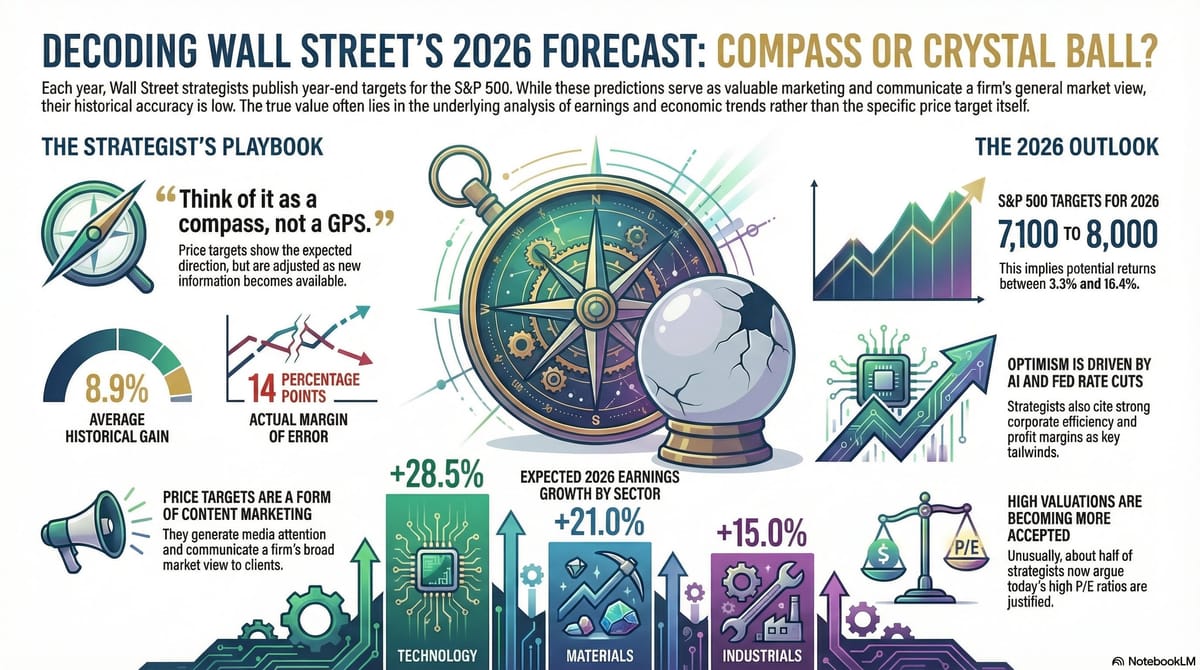
Here's a detailed outlook for the market heading into 2026, characterized by high earnings expectations, elevated valuations, and a shift in market leadership.
- S&P 500 Price Targets and Expected Returns: Wall Street strategists have set year-end 2026 price targets for the S&P 500 ranging from 7,100 to 8,000. These targets imply annual returns between 3.3% and 16.4%. While the average strategist forecast historically clusters around 8.9%, the sources note a significant historical margin of error of approximately 14 percentage points relative to actual performance.
- Strong Earnings Growth Projections: The bullish sentiment is underpinned by expectations of robust corporate earnings, with a market consensus of 14% growth for 2026. Some strategists, like Mike Wilson of Morgan Stanley, are even more optimistic, forecasting 17% earnings growth driven by AI-related efficiencies, business-friendly regulations, and expanding profit margins.
- Elevated Valuations and "Bubble" Discourse: The S&P 500 is currently trading at a forward PE ratio of 21–22x, which is notably higher than the historical average. Despite this, roughly half of the strategists surveyed believe these high multiples are justified by the early stages of AI buildout and productivity potential. Some analysts even project implied PE ratios as high as 26x.
- Anticipated Midterm Election Volatility: The year 2026 is a midterm election year, which historically introduces significant market turbulence. Data from the sources indicate that since 1946, midterm election years have experienced an average intra-year drawdown of 18%.
- Broadening Market Breadth and Small-Cap Strength: Market leadership is diversifying away from a few tech giants; for the first time since 2021, the "Mag 7" stocks accounted for less than half of the market's overall gains, contributing 8% to a 17% total index rise. Furthermore, the small-cap Russell 2000 recently outperformed every S&P 500 sector following the November lows, with 67% of its constituent stocks trading above their 200-day moving average.
- International Opportunities in Japan: The sources make a case for diversifying into Japanese stocks, which trade at a cheaper valuation of 16x earnings compared to the U.S. market. The Nikkei 225 has shown strength, rising 26% this year, supported by corporate governance reforms and a Japanese fiscal stimulus plan equivalent to 3.5% of their GDP.
Understanding these forecasts is like using a compass rather than a GPS; while they provide a general sense of the market's intended direction based on current data, they are frequently recalibrated as new economic information comes to light.