The Dollar's 14-Year Support Trendline

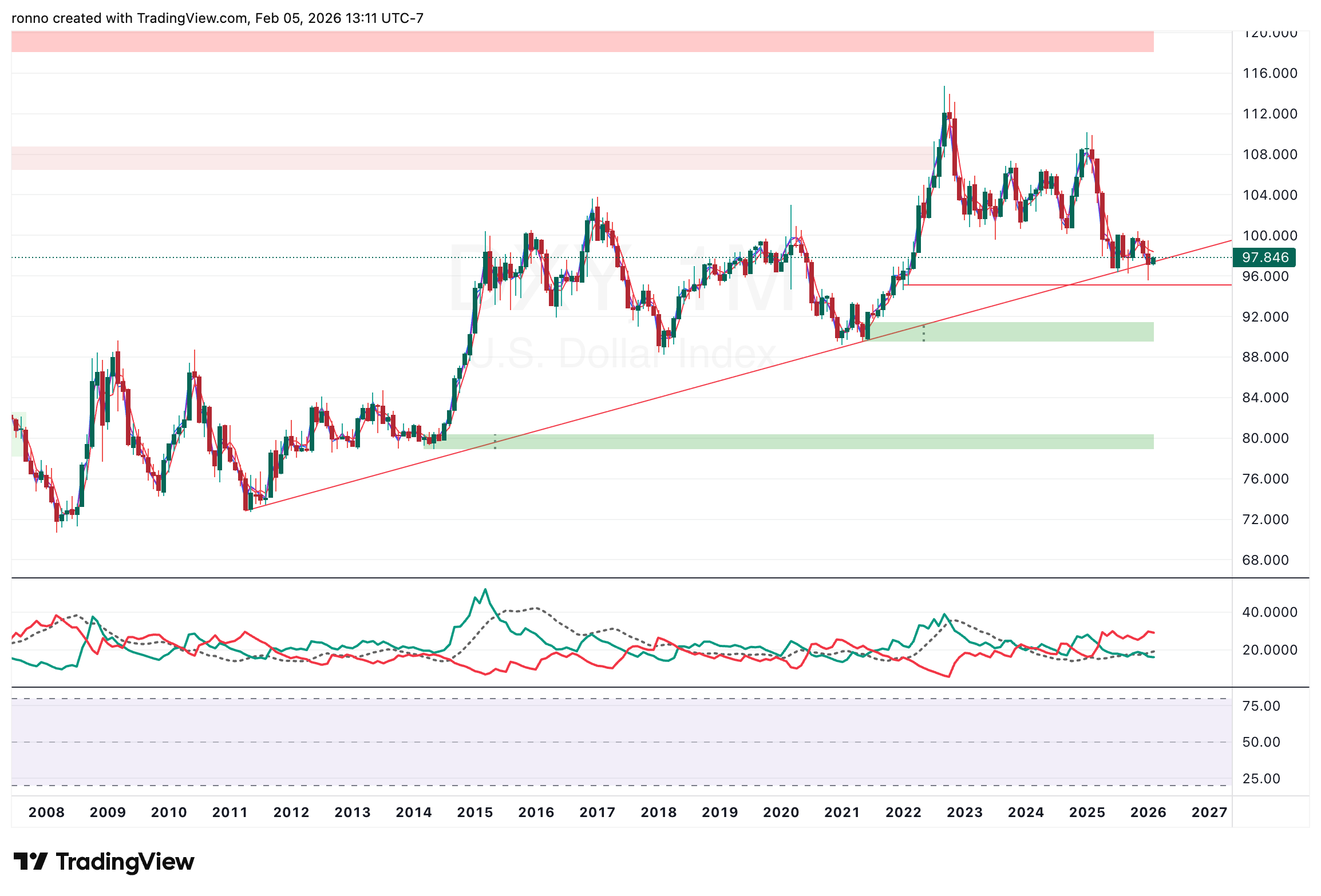
The relationship between the US Dollar (USD) and gold is currently at a critical technical juncture, as the dollar sits on the edge of a 14-to-15-year support trendline. Some indicate that this level is a "danger zone" for the currency, and its potential breakdown could serve as a massive catalyst for precious metals.
The Dollar's 14-Year Support Trendline
The US Dollar Index (DXY) is currently testing an up-sloping trendline that has acted as support since approximately 2011.
- The Danger Zone: The index has recently breached this 14-year support slightly, though it remains in a zone where it could still bounce back. Visual data shows the DXY sitting right on this long-term ascending line at approximately 97.846.
- Subsequent Support Levels: If the dollar fails to hold this 14-year trendline, analysts point to a "demand zone" between 94.50 and 93.25 based on a historical "W" double-bottom pattern.
- Long-Term Projections: Historical currency trends often last for long periods—averaging around 340 weeks. If the current downward momentum continues through the end of the decade, some technical models suggest the dollar could objectively fall as low as 62 or 63.
The Inverse Correlation with Gold
The sources highlight a strong negative correlation between the USD and gold, often described as the "everything but the dollar" trade.
- Price Catalyst: Analysts suggest that a significant weakening of the dollar is the necessary catalyst to double gold prices from current levels.
- The Path to $10,000: If the dollar breaks its 14-year support and continues toward the decade-end targets of 62–63, it creates a technical path for gold to reach $10,000 by the end of the decade.
- Short-Term Sensitivity: This relationship is highly sensitive; recent market updates show that even a small "bounce" in the dollar causes gold to pull back immediately.
The "Sell America" Theme and Currency Risk
The potential breakdown of the dollar trendline is closely tied to a broader shift in global asset allocation:
- Central Bank Activity: Global central banks are currently "loading up" on gold, and for the first time since the 1990s, they own more gold than US Treasuries. This "Sell America" theme involves moving away from USD-based assets in favor of hard assets.
- Foreign Investor Risk: For foreign investors, a breaking dollar trendline creates currency risk. If the value of the dollar drops, foreigners lose money on their US holdings even if the asset price remains stable, making US Treasuries less attractive.
- Unintended Consequences: A breakdown of the dollar support could lead to the unintended consequence of rising domestic interest rates. To entice foreign purchasers to continue buying US Treasuries despite the currency risk, rates would likely have to rise.
Investment Strategy in a Weak Dollar Environment
Because gold serves as a chaos and currency hedge, it is expected to shine in a regime marked by dollar debasement and a loss of confidence in fiat currency. For those following a "Stagflation Playbook," a 10% allocation to gold (IAU) is recommended to protect real wealth against these currency fluctuations. However, investors are cautioned that gold's recent move has been "parabolic," and a sudden rally in the dollar could trigger violent snapbacks in metal prices.